


Quick Answer: A-Levels are one route into a UK university, not the only one. Universities compare qualifications using the UCAS Tariff points system, where an Access to Higher Education Diploma, a BTEC National, a T-Level, or an integrated foundation year can all carry equivalent weight to A-Level grades. Most standard degrees ask for somewhere between 96 and 144 UCAS points, and there are genuine, widely accepted routes to reach that without ever sitting an A-Level, whether you are a school leaver who took a different path or an adult returning to education.
If you left school without A-Levels, or your results did not come out the way you hoped, it can feel like university closes its doors. It does not. UK universities assess a wide range of Level 3 qualifications, and hundreds of institutions accept them every year from students who took a completely different route to get there. This guide covers how the comparison system actually works, the main alternative routes, and how to apply.
How Do Universities Actually Compare Qualifications Without A-Levels?
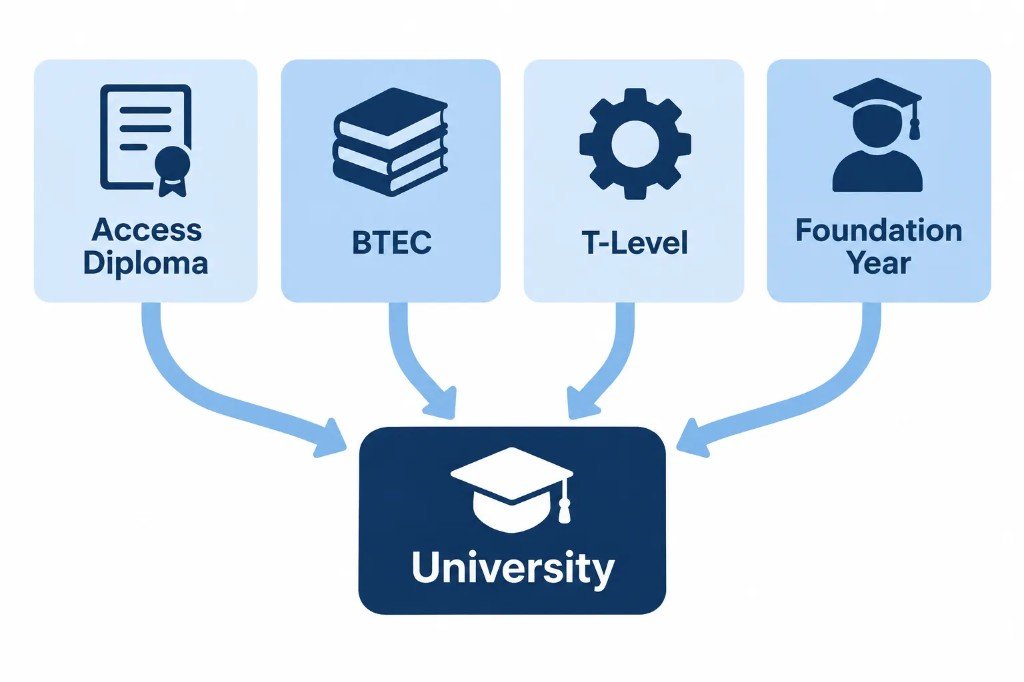
Universities use the UCAS Tariff, a points system that converts different post-16 qualifications into a comparable score. According to UCAS's own guidance, most standard degrees ask for between 96 and 120 points, roughly equivalent to CCC to BBB at A-Level, while more competitive courses often ask for 144 points or more.
Qualification | Points for a Strong Grade Profile | Roughly Equivalent To |
A-Level | 48 points per A grade | — |
Access to Higher Education Diploma | 144 points for 45 Distinction credits | Three A grades at A-Level |
BTEC National Extended Diploma | Up to 168 points at D*D*D* | Three A* grades at A-Level |
T-Level | Up to 168 points at Distinction* | Three A* grades at A-Level |
The key point is that these are not consolation qualifications. A strong Access Diploma or BTEC profile carries genuine equivalent weight, not a discounted version of an A-Level offer.
Route 1: Access to Higher Education Diploma

The Access to Higher Education Diploma is specifically designed for adults aged 19 and over returning to education, though some colleges accept slightly younger students in certain circumstances. It typically takes one year to complete at a further education college and is recognised by the large majority of UK universities as a direct entry qualification.
Most Access Diplomas focus on a subject area, such as Health and Social Care, Nursing, Business or Law, which means the qualification also helps confirm whether your chosen degree subject is genuinely the right fit before you commit three years to it.
Route 2: BTEC and Other Vocational Qualifications
A BTEC National Extended Diploma is treated as equivalent to three A-Levels by the vast majority of UK universities, including many that also accept A-Level applicants for the same course. BTECs combine coursework and practical assessment with exams, which suits students who prefer applied, project based learning over exam heavy A-Level study.
Other vocational routes, including some Level 3 Diplomas in specific sectors, are accepted in a similar way, though it is always worth checking a specific course's entry page rather than assuming every vocational qualification is treated identically.
Route 3: T-Levels

T-Levels are newer two-year qualifications, equivalent to three A-Levels, combining around 80% classroom learning with a mandatory work placement of at least 45 days. A Distinction grade profile can carry up to 168 UCAS points, the same as three A* grades at A-Level.
Because T-Levels are still relatively new, it is worth double checking that your specific target course accepts them, since not every university has updated every course listing at the same pace.
Route 4: An Integrated Foundation Year
An integrated foundation year is a one year programme built into a single four year degree, designed specifically for students who do not meet direct entry requirements through any Level 3 qualification. It typically carries lower entry requirements than the routes above and leads directly into year one of your chosen degree on successful completion.
This route suits students who want a more gradual academic step up, since a foundation year is built around preparing you for exactly the degree you are aiming for, rather than a general Level 3 qualification you complete before applying separately.
What Is New for 2026: Apprenticeships Now Carry UCAS Points Too

From the 2026 cycle onward, UCAS has extended its Tariff points system to include eligible apprenticeships, allowing time spent in an apprenticeship to count toward university entry in a way it did not before. This is a genuinely significant, recent change, and worth knowing about if you have completed or are partway through an apprenticeship and are now considering university.
Which Route Is Right for You?
If you are an adult returning to education after several years away, an Access to Higher Education Diploma is usually the most direct and widely recognised route. If you are a school leaver who prefers practical, applied learning, a BTEC or T-Level may suit you better than repeating a more exam focused Level 3 qualification. If you are unsure which subject you want to commit to, a foundation year offers a gentler, subject specific way in.
It is worth being realistic that the most selective universities, including Oxford, Cambridge and some highly competitive courses elsewhere, still largely expect traditional A-Level grades, so these alternative routes work best for the large majority of UK universities and courses rather than every single one.
How Do You Apply Without A-Levels?
1. Decide which alternative route fits your situation: Access Diploma, BTEC, T-Level, apprenticeship, or an integrated foundation year
2. Check your specific target course's entry page to confirm it accepts that qualification, rather than assuming every course at a university treats all routes the same
3. Enrol in your chosen Level 3 qualification if you have not already, ideally checking it is specifically recognised by your target universities
4. Gather references, a personal statement and any prior certificates before you apply through UCAS
5. Confirm your predicted or achieved UCAS Tariff points against your target course's published requirement before submitting
A short conversation with an advisor before you commit to a specific Level 3 qualification is genuinely useful here, since not every Access Diploma or BTEC subject area is recognised equally by every university offering your target course. Our Course Finder is a good place to start comparing options.
Frequently Asked Questions
Can I get into a Russell Group university without A-Levels?
Many Russell Group universities do accept strong Access Diploma, BTEC or T-Level profiles for specific courses, though the most selective institutions and courses, including Oxford and Cambridge, largely still expect traditional A-Levels.
Is an Access to Higher Education Diploma harder than A-Levels?
It is different rather than harder or easier, generally more coursework based and specifically designed for adult learners, though it demands genuine academic commitment over its one year length.
Can I combine different qualifications to reach the UCAS points I need?
In many cases, yes, since the UCAS Tariff is designed to combine different qualification types into one overall points total, though it is worth checking your specific target course's requirements directly.
What if I have no UCAS points at all?
Some universities, and routes like the Open University, still offer entry options for applicants with no UCAS points, often based on other evidence such as relevant work experience or a portfolio, though options are more limited than with a recognised Level 3 qualification.
Do I need to resit my education from the start if I do not have A-Levels?
No. Every route covered here is designed to move you toward university within a similar timeframe to A-Levels, typically one to two years, rather than requiring you to restart your education from an earlier point.
Final Thoughts
Not having A-Levels genuinely does not close the door to a UK degree. Whichever route fits your situation, from an Access Diploma to a foundation year, the goal is the same UCAS points total and the same degree at the end of it.
If you are weighing up which route makes sense for you, our Course Finder is a good place to compare options by subject, and our Foundation Year guide covers that specific route in more detail. When you are ready, get in touch with our team or head straight to Apply Now.